Minnesota Trout UnlimitedMinnesota Trout Unlimited
  • HOME
  • ABOUT
    • Chapters
    • About
    • Join TU
    • Contact Us
    • How to Support Us
  • NEWS
    • Blog
    • Events
    • Monthly Enews
    • Trout Unlimited Minnesota
  • HABITAT
    • Visit Recent Projects
  • EDUCATION
    • Education and Outreach
    • Trout in the Classroom
    • Fishing Skills Programs
    • Great Waters Fly Fishing Expo
    • Foster the Outdoors Program
    • T.U.N.E Camp
  • ADVOCACY
    • Agricultural Runoff
    • Data Centers
    • Feedlots
    • Neonics
    • Nitrates
    • Preventing Fish Kills
    • Public Waters
    • Sulfide Mining
  • FISHING
  • DONATE
  • HOME
  • ABOUT
    • Chapters
    • About
    • Join TU
    • Contact Us
    • How to Support Us
  • NEWS
    • Blog
    • Events
    • Monthly Enews
    • Trout Unlimited Minnesota
  • HABITAT
    • Visit Recent Projects
  • EDUCATION
    • Education and Outreach
    • Trout in the Classroom
    • Fishing Skills Programs
    • Great Waters Fly Fishing Expo
    • Foster the Outdoors Program
    • T.U.N.E Camp
  • ADVOCACY
    • Agricultural Runoff
    • Data Centers
    • Feedlots
    • Neonics
    • Nitrates
    • Preventing Fish Kills
    • Public Waters
    • Sulfide Mining
  • FISHING
  • DONATE

Why Toewood Is Showing Up Along Minnesota Trout Streams

Kristen Poppleton2026-02-16T15:45:57+00:00

By Dr. Jennifer Biederman

Walk a recently restored bend of a trout stream anywhere in Minnesota and you may notice a line of logs tucked tight to the bank, some with their rootwads still attached. That isn’t debris. It’s a feature called toewood, a design approach that uses large wood to stabilize eroding banks while building the kind of natural habitat structure trout actually use.

What toewood is and how it works

Crews key logs into the lower part of the bank (also called the “toe”), overlap them like shingles, and bury them with native soil. The rough face breaks up near-bank velocity and spreads shear stress; the rootwads add pockets and shade. With seeding, live stakes, and a bit of time, the bank vegetates, and the channel can reconnect to its floodplain.

Why not just use rock?

Rock riprap still has a place in stream restoration, especially where failure would put roads, bridges, or utilities at risk. It’s strong and immediate, but rock along the bank toe tends to deflect energy with the smooth rocky surfaces. In contrast, toewood roughens the margin, slows the current, and creates habitat while it stabilizes. Many MNTU projects combine both: wood at the edge to create habitat, anchored by hidden rock for strength.

Habitat benefits anglers notice

Anglers may notice the benefits right away: rootwads carve ledges, slots, and undercuts that create dependable holding water for trout of all sizes; shaded margins and a reconnected floodplain help keep temperatures cooler in summer.

Think of toewood as a living undercut bank. It rewards deliberate, accurate presentations and good fish-handling. Target the line where faster mid-channel water brushes the wood. Fish also sit behind individual rootwads and at the heads and tails of the scour pool. In summer, a hopper-dropper tight to the wood covers both the surface and the seam (try a small perdigon, PT, or scud). For nymphing, keep casts short and high-stick a tungsten fly along the face. With streamers, swing a small sculpin or muddler down-and-across; many strikes may come as the fly sweeps past the rootwad.

The bigger picture

For MNTU, the goal is not just to “hold the bank.” It’s to restore function, including banks that resist erosion, channels that can move a little without failing, and cover habitat that supports abundant fish and invertebrates. Toewood helps on all three of these counts, and when combined with thoughtful planting and selective rock, it produces reaches that are both stable and full of trout.
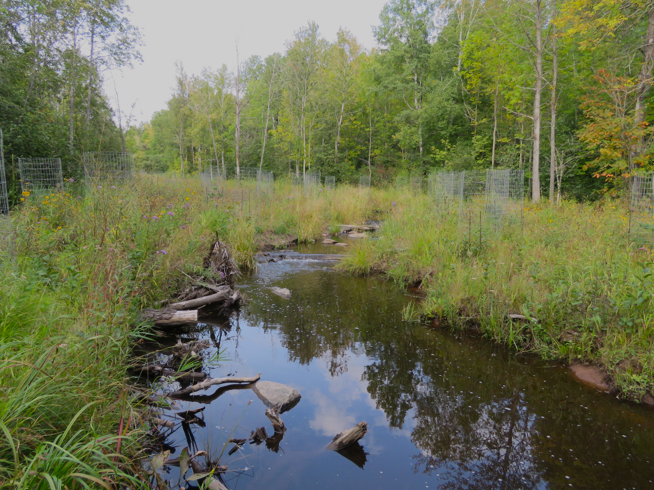
Toewood bend at Keene Creek (Hermantown).
Share this post

Facebook Twitter Email

Related Posts

Bob Luck Eagle Creek Brook Trout

MNTU Habitat E-news: February 2026

Spotlight: Eagle Creek Habitat Improvement Project (Savage, MN) This spring, Minnesota Trout Unlimited (MNTU) will begin construction on a 2,000-foot trout... read more

The Importance of Pools as Trout Habitat in Stream Restoration

On a rainy afternoon a few months ago, I stopped at a newly constructed project on my way home to... read more

Moving the Needle on Fish Passage in Northeastern Minnesota

Fish passage is not always just about fish passage. A culvert replacement might start as a solution to a barrier... read more

Evaluating Stream Habitat Designs Across Southeast Minnesota

Over the past few decades, Minnesota has made tremendous progress in restoring and enhancing its coldwater streams. Across the state,... read more

What Happens After Stream Restoration? From Bare Soil to Cover Crops to Thriving Native Habitat

When a stream restoration project wraps up, the work on the ground is just beginning. During construction, streambanks are graded... read more

Duluth’s Amity Creek Receives New Protection!

MNTU is proud to be a part of an effort to add the highest level of protections to over 1,100... read more

Habitat Director’s Report from the Field, July 2025

July is the heart of field season when it comes to carrying out stream restoration work across the state. Tackling... read more

MNTU’s barrier removal projects also benefit aquatic invertebrates

When most trout anglers think about culvert replacements, they rightly think of trout passage to critical habitat.   Undersized, perched, and... read more

Trees for Trout: An Update on MNTU’s Riparian Reforestation Project 

If you’ve fished along a trout stream in northeast Minnesota lately, you’ve probably noticed the standing dead spruce and balsam... read more

MNTU Kicks Off the Field Season with a Riparian Forestry Project on the Sucker River

Minnesota Trout Unlimited is dedicated to preserving and improving the health of trout streams across the state. During these cold... read more

Join MNTU
Donate

Recent Posts

  • Contact your Senators to protect the BWCAW
  • Community Science for Winter Anglers: Bugs Below Zero
  • Trout in the Classroom Update – February 2026
  • MNTU Habitat E-news: February 2026
  • An 8-Year Look at the MNTU Education Program

Categories

  • Action Alerts
  • Advocacy
  • Donations
  • Education
  • Fishing
  • Habitat
  • Legislation
  • Macro of the Month
  • News
  • Policy
  • Trout In The Classroom
  • Volunteer Spotlight
Minnesota Trout Unlimited
  • Facebook
  • Instagram
  • YouTube
  • Contact your Senators to protect the BWCAW
  • Community Science for Winter Anglers: Bugs Below Zero
  • Trout in the Classroom Update – February 2026
  • MNTU Habitat E-news: February 2026
  • An 8-Year Look at the MNTU Education Program
  • Winter Fly Fishing in Minnesota’s Driftless
  • The Importance of Pools as Trout Habitat in Stream Restoration
  • What Happens to Aquatic Invertebrates as Winter Sets In?
  • Moving the Needle on Fish Passage in Northeastern Minnesota
  • 12,000 Eggs Delivered for Trout In The Classroom
  • November 2025 Macro of the Month- Northern Caddisflies
  • Action Alerts
  • Advocacy
  • Donations
  • Education
  • Fishing
  • Habitat
  • Legislation
  • Macro of the Month
  • News
  • Policy
  • Trout In The Classroom
  • Volunteer Spotlight

Send all correspondence to:

Minnesota Trout Unlimited

P.O. Box 845

Chanhassen, MN 55317

Join MNTU
Donate

© Copyright 2026 Minnesota Trout Unlimited. All Rights Reserved.