
What happens to aquatic invertebrates as winter sets in?
Macro of the Month – December 2025
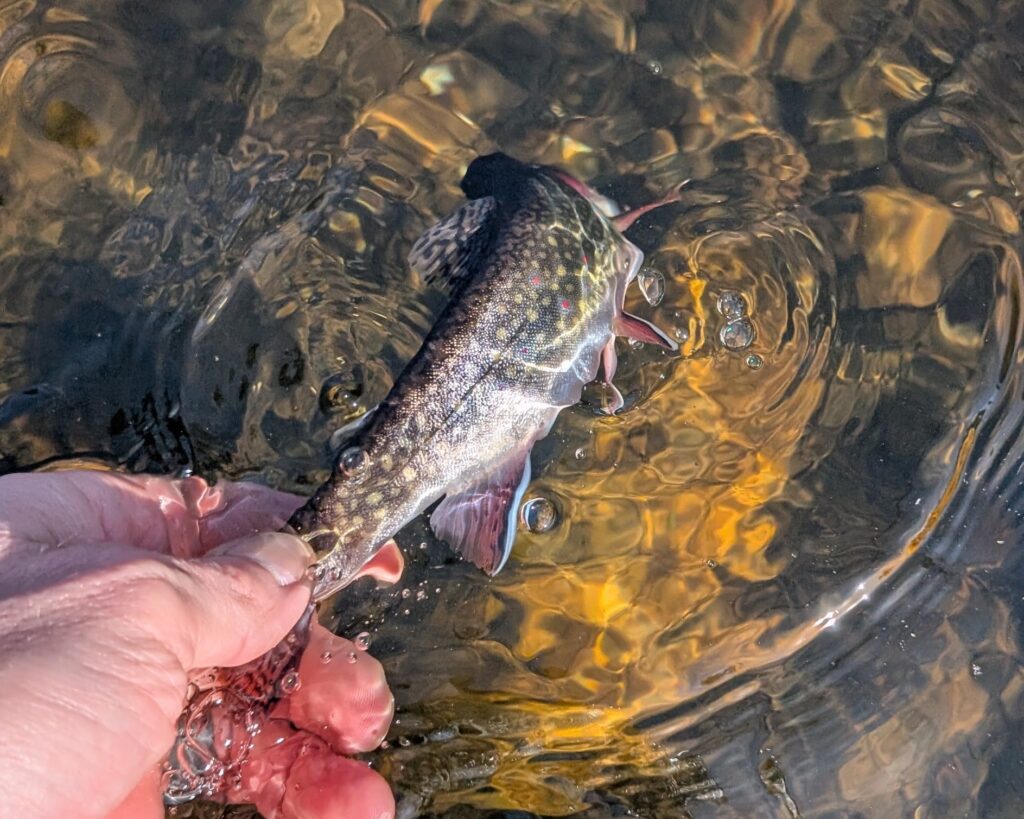
December has always been one of my favorite times to walk a trout stream. The leaves are down, the cold air is fresh, and in many of our springfed trout streams across the state, the water is still flowing. When I bend over to flip over a rock or two, the stream tells a really cool story about what winter is like under the surface – one of persistence and resilience. Even as snow settles on the box elders and willows, and anchor ice forms in the margins, the stream’s tiniest little residents are still awake and moving.
Most people assume that aquatic insects and other macroinvertebrates simply “shut down” when winter sets in. But in reality, winter is one of the most ecologically fascinating periods in a trout stream, full of specialized strategies, migrations, life-stage shifts, and little bursts of activity that keep the food web functioning. Especially in the most groundwater-fed streams, particularly in southeast Minnesota, although you’ll notice a considerably sharp decrease in air temperature, springs provide a thermal buffering that keeps water temperatures constant. This, along with unique adaptations to survive where winter water temperatures do plummet a bit, enables many macroinvertebrates to survive and thrive all winter long.
Unlike fish, aquatic invertebrates don’t swim to deeper pools or thermally stable springs to escape the cold. Instead, they employ three primary overwintering strategies:
1. Cold-Hardiness
Many macroinvertebrates, especially mayflies, stoneflies, caddisflies and winter-emerging midges, have evolved biochemical antifreeze compounds that prevent ice crystals from forming inside their cells. These “cryoprotectants” allow nymphs to remain active at temperatures just above freezing.
2. Microhabitat Refuge
When surface ice forms, macroinvertebrates retreat into:
- Gravel and cobble interstitial spaces
- Leaf packs lodged in riffles and along margins of streams
- Underwater root wads
- The hyporheic zone where a warmer layer where groundwater interacts with surface water
These locations buffer against temperature swings and anchor ice, protecting invertebrates from harsher winter conditions.
3. Life Stage Timing
Some species avoid winter entirely by being:
- Eggs (many caddisflies)
- Diapausing larvae (chironomids)
- Pupae (some mayflies)
Others, like winter stoneflies, are uniquely adapted to grow during winter, taking advantage of predator-poor conditions.
Who’s Still Active in December? More Than You Think
You might be surprised by how many aquatic invertebrates stay active under ice:
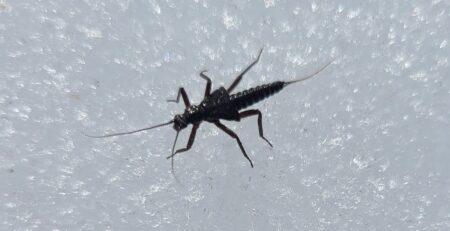
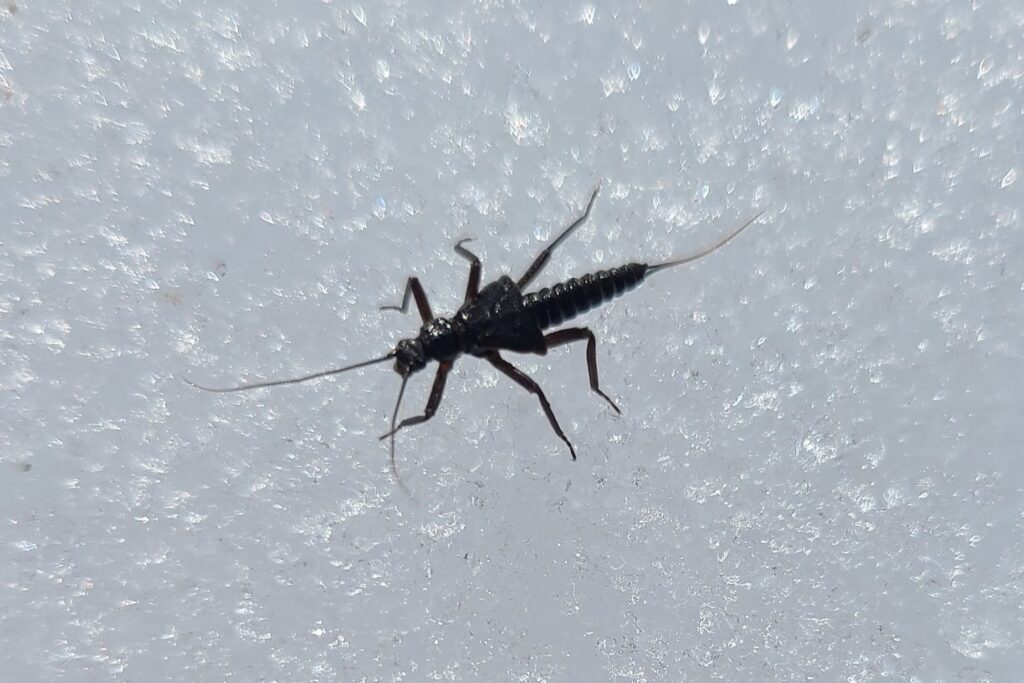
Winter Stoneflies (Plecoptera: Capniidae, Taeniopterygidae)
These taxa are iconic of a winter stream. As water temperatures fall, their metabolism elevates, allowing them to feed and mature at a time when competition is low. Nymphs cling to gravel in fast, well-oxygenated riffles, which are some of the only places with open flow when ice forms.
By late December or early January, adults may emerge on warmer days, skittering across snowbanks. Their presence is a great indicator of a resilient, groundwater-fed system.
Chironomid Midges (Diptera: Chironomidae)
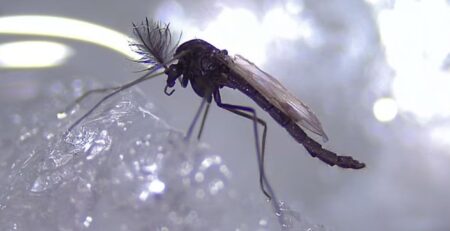
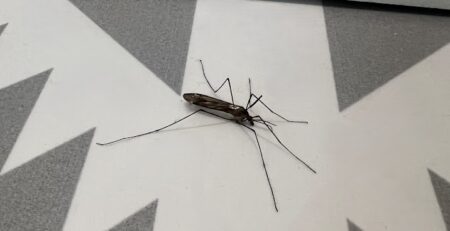
Midges are among my favorite macroinvertebrates. They are truly workhorses of the winter food web. Chironomid larvae, some bright red from hemoglobin, remain active year-round in riffles, pools, and even slow runs. They tolerate low oxygen, low light, and near-freezing water. Midges often hatch on sunny winter afternoons, providing trout with rare winter surface opportunities. In fact, there is still little known about the life history patterns and taxonomy of the winter-emerging midges, but the University of Minnesota has a great research group dedicated to this taxa, along with a really cool citizen science monitoring program, Bugs Below Zero, that gathers information about winter stream invertebrates.
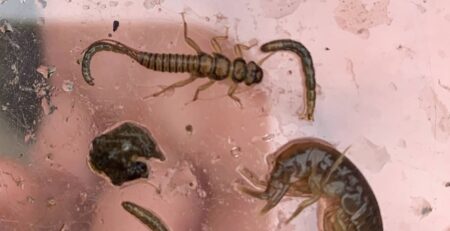
Scuds (Gammarus spp.)
In groundwater-rich, vegetated streams, scuds continue their role as energy-rich grazers throughout winter. Their movement remains surprisingly high in December, especially in the coldwater streams where water temps hover in the upper 30s. Trout rely on scuds (along with midges) heavily this time of year.
Caddisflies, Mayflies, and Others
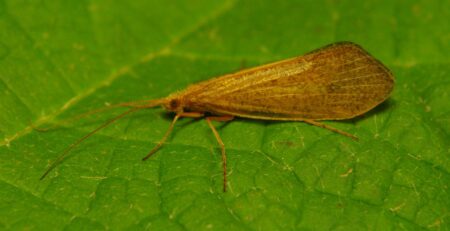
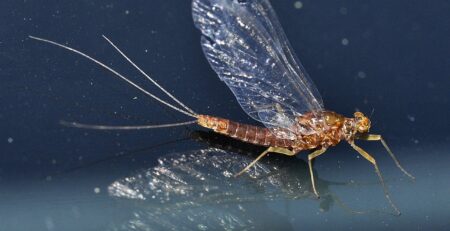
While many species overwinter as eggs or diapause larvae, some mayfly nymphs, especially Baetis, remain active and available as food. Certain caddisfly larvae stay in their cases, slowly grazing algae beneath any surface ice. Aquatic worms, sowbugs, and crustaceans also continue feeding and cycling nutrients.
The takeaway is that winter does not mean dormancy. It means selective activity, often tightly matched to groundwater, streamflow stability, and habitat complexity.
Winter in the Food Web: Who Eats Whom?
Even though aquatic insect metabolism slows, the food web keeps turning. In fact, winter foraging patterns reveal some of the best evidence of a stream’s underlying health.
Trout depend strongly on benthic prey in winter, especially:
- Chironomid larvae and pupae
- Small stonefly nymphs
- Scuds
- Aquatic worms
- Amphipods
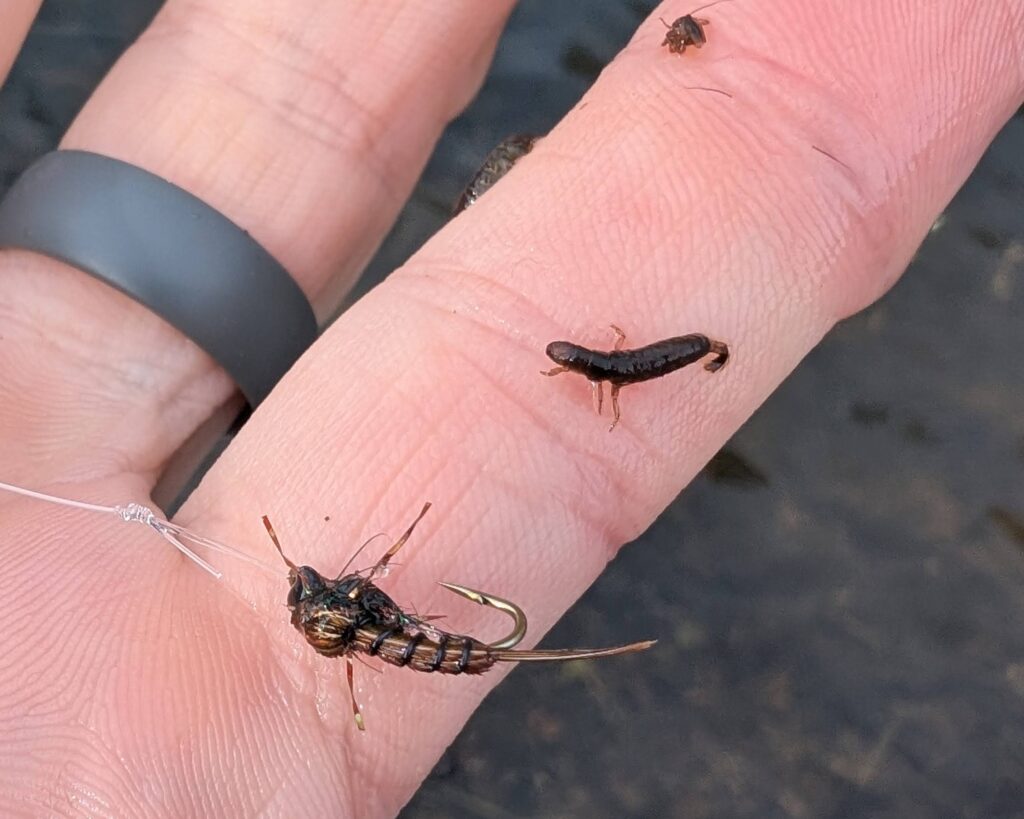
Because drift rates decrease in cold water, trout shift to more benthic foraging, tight to the substrate and picking off inverts directly from the bottom. Winter-stonefly nymphs, with their sometimes clumsy crawling movements, are an underrated food item.
Predation, in turn, shapes invertebrate behavior. Many species reduce movement to avoid detection, while others (like Baetis mayflies) engage in short bursts of activity during small temperature bumps. These tiny pulses of movement can coincide with midday feeding windows for trout.
Why This Matters for Conservation
Winter is when the backbone of a coldwater system is revealed. Streams with:
- Stable groundwater inputs
- Low fine sediment
- Abundant cobble and root structure
- Oxygen-rich riffles
Support thriving winter invertebrate communities and thus healthier trout populations.
Conversely, channels suffering from sedimentation, low flow, or reduced connectivity struggle to maintain winter insect diversity. By the time spring comes, those deficits show up in fewer stoneflies, fewer scuds, and weaker year-class trout.
This is exactly why habitat restoration and protection efforts, whether adding large wood, reconnecting floodplains, reducing fine sediment inputs, or improving hydrology – matter just as much in winter as they do in summer.